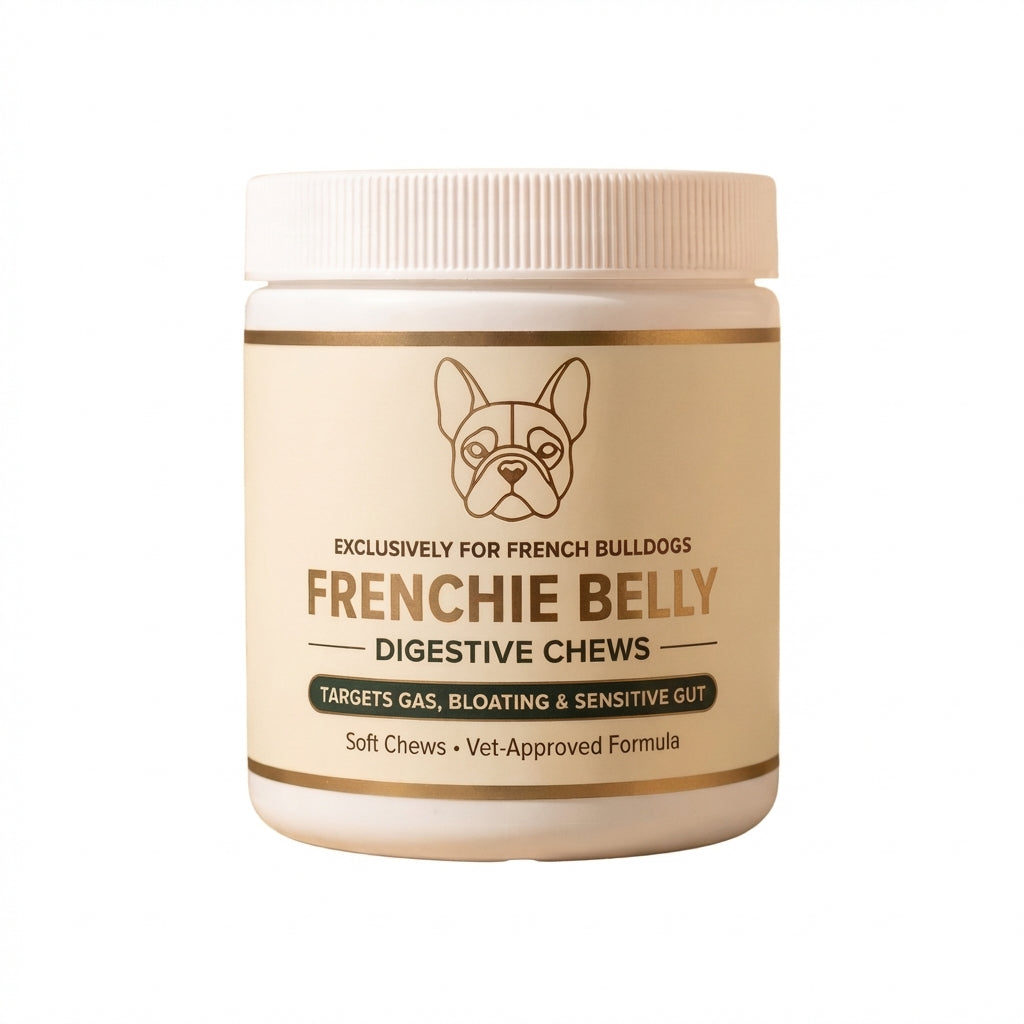
What to Look for in a French Bulldog Probiotic (2026 Guide)

Key Takeaways
- Look for multi-strain formulas with Enterococcus faecium + Lactobacillus acidophilus as a minimum — these have the strongest evidence
- CFU count matters: minimum 1 billion per serving, 5-10 billion for recovery from antibiotics or chronic issues
- Powders deliver more viable bacteria than chews, but chews work well if CFUs are verified at expiration
- Prebiotics (inulin, FOS, pumpkin fiber) are essential — they feed the probiotics and help them colonize
In This Article
- Why French Bulldogs Need Probiotics More Than Most Breeds
- The 5 Probiotic Strains That Matter for Dogs
- CFU Count: How Much Actually Matters
- Format Comparison: Chews vs. Powders vs. Capsules
- Prebiotics: The Missing Piece Most Owners Overlook
- Red Flags: What to Avoid
- Natural Probiotic Sources for French Bulldogs
- How to Introduce Probiotics to Your Frenchie
- What Results to Expect (And When)
Walk into any pet store or browse Amazon for "dog probiotics" and you'll find hundreds of options — each claiming to be the best. But French Bulldogs aren't like other dogs. Their unique digestive challenges (brachycephalic aerophagia, genetic predisposition to gut dysbiosis, high rates of food sensitivities) mean they need a probiotic that's more than just a generic supplement.
This guide cuts through the marketing noise and explains exactly what to look for — which strains, how many CFUs, what format, and what to avoid — so you can choose a probiotic that actually makes a difference for your Frenchie's gut health.
Why French Bulldogs Need Probiotics More Than Most Breeds
Before diving into what to look for, it's worth understanding why probiotics matter more for Frenchies than for, say, a Golden Retriever:
- Breed-specific gut dysbiosis — French Bulldogs are genetically prone to imbalances between beneficial and harmful gut bacteria. Their immune-reactive profile disrupts the microbiome more easily and more frequently than in other breeds.
- Chronic aerophagia — constant air swallowing from their brachycephalic anatomy creates a stomach environment where gas-producing bacteria can thrive
- Frequent antibiotic use — Frenchies' susceptibility to skin infections, ear infections, and UTIs means they're often prescribed antibiotics, which devastate beneficial gut bacteria
- High food sensitivity rates — impaired gut barrier function (often called "leaky gut") allows food proteins to trigger immune responses, creating a cycle of inflammation
A good probiotic doesn't just "help with digestion" — for a French Bulldog, it actively counteracts breed-specific vulnerabilities that are otherwise difficult to manage.
The 5 Probiotic Strains That Matter for Dogs
Not all probiotics are equal. Here are the strains with actual scientific evidence behind them for canine gut health:
| Strain | What It Does | Evidence | Priority |
|---|---|---|---|
| Enterococcus faecium | Reduces acute diarrhea by up to 50%, supports immune function | EFSA approved, multiple clinical trials | Must-have |
| Lactobacillus acidophilus | Strengthens intestinal barrier, improves stool quality | Clinical studies in dogs | Must-have |
| Bacillus coagulans | Spore-forming — survives stomach acid, shelf-stable | EFSA approved for dogs | Highly recommended |
| Bifidobacterium animalis | Supports overall microbial balance, anti-inflammatory | Multiple veterinary studies | Recommended |
| Saccharomyces boulardii | Beneficial yeast — effective against antibiotic-associated diarrhea | Strong human evidence, growing canine data | Excellent post-antibiotics |
The takeaway: Look for a probiotic that contains at least Enterococcus faecium AND Lactobacillus acidophilus as a minimum. Multi-strain formulas that include 3-5 of these strains provide broader support, because different strains colonize different parts of the GI tract.
Why Multi-Strain Beats Single-Strain
Your Frenchie's gut contains hundreds of bacterial species across five dominant phyla (Firmicutes, Fusobacteria, Bacteroidetes, Proteobacteria, and Actinobacteria). A single-strain probiotic is like trying to replant an entire forest by planting one type of tree. Multi-strain formulas provide a wider range of bacterial diversity, which is exactly what a dysbiotic French Bulldog gut needs.
A 2020 study published in Frontiers in Veterinary Science tested an 8-strain formula (Slab51) containing L. acidophilus, L. plantarum, L. rhamnosus, Bifidobacterium lactis, and others on 20 dogs. The results showed safe immune stimulation and favorable microbiota shifts — something no single-strain product has been able to replicate. Multi-strain formulas work because different strains colonize different parts of the GI tract, providing broader coverage.
Special Mention: Saccharomyces boulardii
This beneficial yeast deserves its own callout. Unlike bacterial probiotics, S. boulardii is naturally resistant to antibiotics — because antibiotics kill bacteria, not yeast. This makes it the only probiotic you can take simultaneously with antibiotics and still get benefits. For French Bulldogs who are frequently prescribed antibiotics for skin fold infections, ear infections, and respiratory issues, a probiotic containing S. boulardii is especially valuable. A 2018 study at the University of Bologna confirmed its effectiveness in dogs with chronic intestinal conditions.
CFU Count: How Much Actually Matters
CFU stands for Colony-Forming Units — the number of viable bacteria per serving. This is one of the most important numbers on the label, and it's where many cheap probiotics fall short.
- Minimum effective dose: 1 billion CFUs per serving
- Optimal range for French Bulldogs: 1-10 billion CFUs per serving
- Post-antibiotic recovery: 5-10 billion CFUs for the first 2-4 weeks
A product with only 10 million (10M) CFUs sounds impressive but is 100x weaker than a 1 billion (1B) CFU product. Many budget probiotics use low CFU counts because they're cheaper to produce — but they won't move the needle for a breed that's actively fighting dysbiosis.
Important detail: The CFU count should be guaranteed "at time of expiration," not "at time of manufacture." Bacteria die during storage — Lactobacillus strains in powder form can lose 50-90% viability within 6-12 months if not stored correctly. A product that starts with 5 billion CFUs but has no expiration guarantee might deliver only 500 million by the time your dog takes it. Look for the phrase "CFU guaranteed through best by date" on the label.
For context, here's what clinical trials have actually used:
- FortiFlora (most-prescribed vet probiotic): 100 million CFUs — effective for acute diarrhea
- Basic gut support studies: 1 billion CFUs (109)
- Chronic GI condition trials: 10-30 billion CFUs daily
- High-end immune support research: 100-200 billion CFUs daily
For a French Bulldog with moderate digestive issues, the 1-10 billion range hits the sweet spot between efficacy and practicality.
Format Comparison: Chews vs. Powders vs. Capsules
The delivery format affects how many viable bacteria actually reach your Frenchie's gut:
| Format | Pros | Cons | Best For |
|---|---|---|---|
| Soft Chews | Dogs love them, easy to give daily, no mess | Heat from manufacturing can kill bacteria, may contain fillers/sugar | Daily maintenance |
| Powders | Highest viable bacteria count, easy to mix with food, no heat processing | Can be messy, picky eaters may refuse | Maximum potency, best overall |
| Capsules | Good shelf stability, precise dosing | Hard to give to dogs, coating must dissolve first | Owners who can pill their dog easily |
| Liquid/Paste | Easy absorption, good for puppies | Shorter shelf life, harder to store | Puppies, acute digestive issues |
Our recommendation: Powders deliver the most viable bacteria per serving because they're not subjected to the heat and pressure of chew manufacturing. Sprinkle on food at mealtime. If your Frenchie won't eat powder on their food, soft chews are the next best option — just make sure the CFU count is verified and high enough (1B+).
Prebiotics: The Missing Piece Most Owners Overlook
Probiotics add beneficial bacteria. Prebiotics feed them. Without prebiotic fiber, the probiotic bacteria you're introducing may not survive long enough to establish themselves.
Think of it like planting seeds (probiotics) in soil (your Frenchie's gut). Without water and fertilizer (prebiotics), the seeds won't grow. The most effective supplements contain both — this combination is called a synbiotic.
Key prebiotic ingredients to look for:
- Inulin — derived from chicory root, one of the most studied prebiotics for dogs
- Fructooligosaccharides (FOS) — selectively feeds beneficial Bifidobacterium species
- Pumpkin fiber — natural prebiotic source that also helps with stool quality
- Psyllium husk — soluble fiber that supports both digestion and probiotic colonization
If your probiotic doesn't include prebiotics, you can add them naturally through pumpkin puree (1-2 tablespoons with meals) or a small amount of cooked sweet potato.
How much prebiotic fiber does your Frenchie actually need? Research suggests that FOS at about 0.45% of total diet produces measurable microbiota shifts in dogs. For a typical French Bulldog eating 200g of dry food per day, that translates to roughly 0.9g of FOS daily — well within the 500mg-2g range that most prebiotic supplements provide per serving. It doesn't take much, but it makes a significant difference in how well the probiotics establish themselves.
Red Flags: What to Avoid
Not every probiotic on the shelf deserves to be there. Watch for these warning signs:
- No specific strain names listed — "contains probiotics" or "proprietary blend" without naming specific strains is a red flag. You should see genus + species + strain (e.g., Enterococcus faecium SF68)
- No CFU count on the label — if they don't tell you how much is in it, assume it's not enough
- Added sugar or artificial sweeteners — sugar feeds harmful bacteria, completely defeating the purpose of a probiotic
- Artificial colors or flavors — unnecessary additives that can trigger sensitivities in Frenchies
- Common allergens as fillers — watch for chicken, wheat, corn, soy, and dairy in the inactive ingredients
- No expiration date or storage instructions — probiotics are living organisms; they degrade over time
- Outrageous health claims — "cures all digestive problems" or "guaranteed results in 24 hours" are marketing, not science
Natural Probiotic Sources for French Bulldogs
Commercial supplements aren't the only option. Several whole foods provide natural probiotics that many Frenchie owners swear by:
Plain Kefir
Kefir contains 30-50 different probiotic strains — far more than any commercial supplement. Use plain, unsweetened kefir from the refrigerated section (not flavored varieties). Start with 1 teaspoon per day and gradually increase to 1-2 tablespoons. Most dogs love the taste.
Raw Goat's Milk
Easier to digest than cow's milk (smaller fat molecules, different protein structure) and packed with natural probiotics and enzymes. Available in the refrigerated section of most pet stores. Give 1-2 tablespoons as a food topper.
Green Tripe (Raw)
The unprocessed stomach lining of ruminant animals is loaded with digestive enzymes and naturally occurring probiotics. Many breeders consider it the single best food for French Bulldog digestion. Available frozen at specialty pet stores — the smell is strong, but dogs go crazy for it.
Fermented Vegetables
Small amounts of plain sauerkraut (from the refrigerated section, not canned) or fermented carrots provide both probiotics and prebiotic fiber. The key word is refrigerated — shelf-stable sauerkraut is pasteurized and contains zero live bacteria. Look for products with only cabbage + salt on the label. Start with 1/2 teaspoon and watch for tolerance. Avoid any fermented vegetables with garlic, onion, or spices — these are toxic to dogs.
Plain Greek Yogurt
An accessible option that most dogs love. It contains Streptococcus thermophilus and Lactobacillus bulgaricus — relatively few strains compared to kefir, but still beneficial. Use plain, non-fat varieties only (flavored yogurts often contain sugars and sometimes xylitol, which is toxic to dogs). Look for "contains live and active cultures" on the label. Good as an occasional food topper, but not potent enough to be your Frenchie's sole probiotic source.
How to Introduce Probiotics to Your Frenchie
Even beneficial bacteria can cause temporary digestive upset if introduced too quickly. Follow this gradual protocol:
- Days 1-3: Give 1/4 of the recommended dose
- Days 4-7: Increase to 1/2 dose
- Days 8-10: Increase to 3/4 dose
- Day 11+: Full recommended dose
Some temporary gas or slight stool changes during the first week are normal — this is called a "die-off" reaction as harmful bacteria are displaced by the new beneficial ones. If symptoms are severe or persist beyond 7-10 days, reduce the dose and try increasing more slowly.
For best results, give probiotics with food — the food acts as a buffer that helps more bacteria survive the acidic stomach environment. Mornings are ideal, since gut motility is highest after overnight fasting. And never mix probiotics with hot food — temperatures above 40°C (104°F) kill bacteria instantly. Let food cool to room temperature before adding the probiotic.
Consistency is key: daily use is far more effective than sporadic dosing. Studies on Lactobacillus strains in dogs confirm that colonization is transient — within 2-4 weeks of stopping supplementation, the microbiome returns to its previous composition. Think of probiotics as ongoing maintenance for your Frenchie's gut, not a one-time course like antibiotics.
What Results to Expect (And When)
Setting realistic expectations prevents premature disappointment. Here's what a typical French Bulldog probiotic timeline looks like based on owner reports and veterinary guidance:
- Days 1-5: Possible increase in gas or slight stool changes — this is normal die-off as harmful bacteria are displaced. Don't stop unless symptoms are severe.
- Week 1-2: Stool consistency begins improving. Many owners notice firmer, more regular bowel movements first.
- Week 2-3: Gas and bloating noticeably decrease. Stomach gurgling reduces.
- Week 4-6: Full gut stabilization. Coat quality may improve as nutrient absorption increases. Energy levels often rise.
- Month 2-3: Immune function improvements become apparent — fewer skin flare-ups, less itching, fewer ear infections in allergy-prone Frenchies.
If you see zero improvement after 4-6 weeks of consistent daily use at proper CFU levels, the issue likely runs deeper than a probiotic can address — consult your veterinarian about potential IBD, EPI, or food allergy testing.
One final tip: if your Frenchie is currently on antibiotics, give the probiotic at least 2 hours after the antibiotic dose to minimize the medication killing the probiotic bacteria. The exception is Saccharomyces boulardii, which can be given simultaneously since antibiotics don't affect yeast.