Why Your French Bulldog Has So Much Gas (And How to Fix It)

Key Takeaways
- French Bulldogs swallow 3x more air than non-brachycephalic breeds due to their flat-face anatomy — this is the #1 cause of gas
- Chicken is the most common food sensitivity trigger in Frenchies — switching to lamb, turkey, or duck often dramatically reduces gas
- A slow feeder bowl + elevated bowl + probiotics is the highest-impact combination for reducing flatulence
- Most owners see significant improvement within 1-3 weeks of dietary and feeding changes
If you've ever been jolted awake by a smell so potent it could clear a room, you probably own a French Bulldog. Frenchie flatulence isn't just a running joke among owners — it's one of the most common health-related concerns in the breed. And while a gassy dog might seem like a minor inconvenience, excessive gas can actually signal deeper digestive issues that deserve your attention.
The good news? Once you understand why your French Bulldog farts so much, you can take targeted steps to reduce it — often dramatically. This guide breaks down the real causes (backed by veterinary research), what actually works, and when it's time to call your vet.
It's Not Just the Food — It's Their Anatomy
Here's something most dog owners don't realize: French Bulldogs are anatomically predisposed to excessive gas. It's not a behavioral quirk or a sign you're feeding the wrong kibble (though diet matters too — we'll get there). It's built into their skull.
French Bulldogs are a brachycephalic breed, meaning they have a shortened skull, compressed nasal passages, and an elongated soft palate. This flat-face anatomy doesn't just cause the adorable snoring — it forces them to work harder with every single breath. And that constant respiratory effort leads to a condition called aerophagia: involuntary air swallowing.
Research published in veterinary journals found that 45.8% of French Bulldogs suffer from aerophagia, compared to just 13.8% in non-brachycephalic breeds. That's more than triple the rate. Every breath, every gulp of water, every excited greeting at the door — they're swallowing air that has to go somewhere.
The Domino Effect Most Vets Don't Explain
But aerophagia is just the beginning. Veterinary researchers at DVM360 have documented a cascading anatomical effect in French Bulldogs that goes far beyond simple air swallowing:
- Aerophagia → excess air fills the stomach
- Oesophageal dysmotility → the esophagus doesn't move food efficiently
- Hiatal herniation → part of the stomach pushes through the diaphragm
- Chronic gastroesophageal reflux → stomach acid backs up
- Delayed gastric emptying → food sits in the stomach longer, fermenting and producing gas
In one fluoroscopy study of 36 brachycephalic dogs, 16 had hiatal hernias — and all 16 were French Bulldogs. The study also found that 31 out of 36 had delayed esophageal transit, and 27 had gastroesophageal reflux.
This isn't just "my dog farts a lot." This is a breed with a fundamentally different digestive architecture than other dogs. Understanding this is the first step to actually fixing the problem.
The 6 Most Common Causes of French Bulldog Gas
While anatomy sets the stage, several factors determine how much gas your Frenchie actually produces. Here are the six most common culprits, ranked by how frequently they're reported by owners and veterinarians:
1. Brachycephalic Aerophagia
As we covered above, your Frenchie swallows air constantly — while breathing, eating, drinking, playing, and getting excited. This swallowed air accumulates in the GI tract and has to exit as either burping or flatulence. It's the baseline cause that makes everything else worse.
2. Food Sensitivities and Allergies
French Bulldogs have one of the highest rates of food sensitivities among all dog breeds. The most common triggers:
| Trigger | How Common | Signs Beyond Gas |
|---|---|---|
| Chicken | Very common | Itchy skin, ear infections, loose stools |
| Dairy | Common | Diarrhea, bloating, vomiting |
| Wheat & Corn | Common | Skin irritation, excessive gas |
| Soy | Moderate | Inflammation, digestive upset |
| Beef | Moderate | GI upset, skin reactions |
| Eggs | Less common | Vomiting, itching |
Chicken is by far the #1 trigger — which is ironic because it's the primary protein in most commercial dog foods. Many Frenchie owners report dramatic improvement simply by switching to a novel protein like lamb, turkey, duck, or bison.
3. Gut Microbiome Dysbiosis
French Bulldogs are genetically predisposed to dysbiosis — an imbalance of good and bad bacteria in the gut. When harmful bacteria outnumber beneficial ones, they produce excess gas through fermentation of undigested food. This isn't just a diet problem; it's a breed-specific genetic tendency that requires ongoing management.
4. Eating Too Fast
Frenchies are enthusiastic eaters. They gulp their food, and with every gulp comes a mouthful of air. Combined with their already elevated aerophagia from breathing, fast eating can double or triple the amount of air entering the digestive system.
5. Table Scraps and Human Food
Dogs lack many of the enzymes needed to break down human food efficiently. High-fat foods, spicy dishes, garlic, onions, and sugary treats are especially problematic for French Bulldogs. Even small amounts can trigger hours of excessive gas.
6. Underlying GI Conditions
In some cases, persistent gas signals a medical condition like inflammatory bowel disease (IBD), exocrine pancreatic insufficiency (EPI), intestinal parasites, or the hiatal hernias mentioned earlier. If gas is accompanied by vomiting, diarrhea, weight loss, or a painful abdomen, a vet visit is essential.
What Actually Reduces French Bulldog Gas
Forget the gimmicks. Here's what veterinarians and experienced Frenchie owners consistently report as effective — ordered by impact:
Switch to a Novel Protein Diet
If your Frenchie is eating chicken-based kibble (most are), try switching to lamb, turkey, duck, bison, or rabbit. This single change resolves gas for a significant percentage of French Bulldogs. Look for limited-ingredient formulas without corn, wheat, soy, or artificial additives.
The transition should be gradual — mix 25% new food with 75% old food for 2-3 days, then 50/50, then 75/25, before fully switching. Abrupt changes will temporarily worsen gas.
One approach that experienced Frenchie owners recommend is a proper elimination diet. Choose a single novel protein your dog has never eaten (like venison or rabbit) paired with a single carb source (like sweet potato). Feed exclusively for 8-12 weeks. If gas improves dramatically, you've confirmed a food sensitivity. You can then slowly reintroduce other proteins one at a time to identify the exact trigger. Most owners find that chicken is the primary culprit — but some Frenchies also react to beef, dairy, or grains.
Use a Slow Feeder Bowl
Slow feeder bowls with ridges or maze patterns force your Frenchie to eat around obstacles, dramatically reducing both eating speed and air intake. Many owners report noticeable improvement within the first week. These cost $10-15 and are one of the highest-impact, lowest-effort changes you can make.
When choosing a slow feeder, look for one with a non-slip base (Frenchies are surprisingly strong pushers) and made from BPA-free materials. Silicone slow feeders are easier to clean than hard plastic ones and tend to be gentler on flat-faced breeds who push their faces deeper into the bowl.
Try an Elevated or Tilted Bowl
Feeding from a bowl raised 4-6 inches off the ground changes the angle of your Frenchie's neck and throat during eating, reducing the amount of air swallowed. Combined with a slow feeder, this addresses the aerophagia component from both angles. The ideal height is roughly level with your dog's lower chest — they shouldn't have to reach down to the floor or stretch up to eat.
Feed Smaller, More Frequent Meals
Instead of one or two large meals, split your Frenchie's daily food into 3-4 smaller portions. Smaller volumes mean less air swallowed per meal and faster digestion, which means less time for fermentation and gas production. This also helps prevent the "vacuum eating" that happens when a hungry Frenchie finally gets their meal after a long wait.
Add a Quality Probiotic
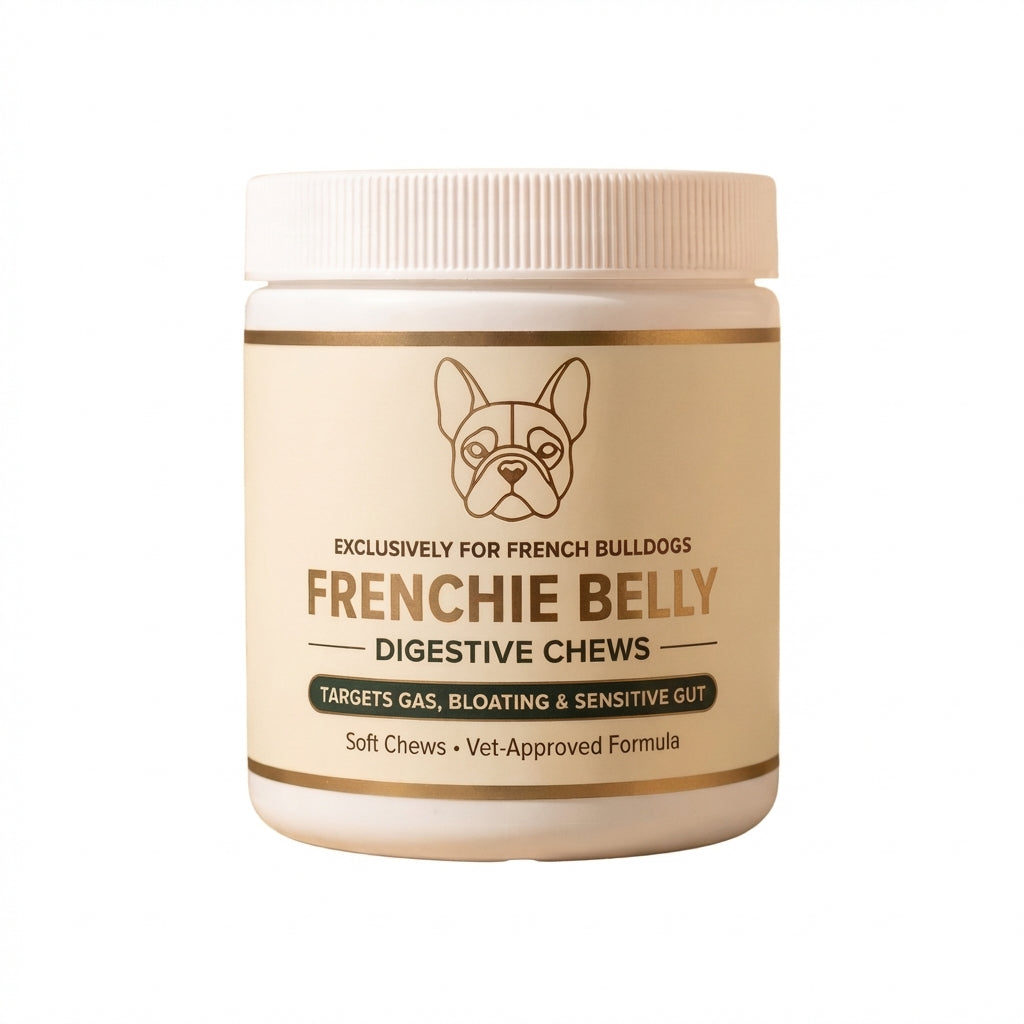
A probiotic supplement can help rebalance your Frenchie's gut microbiome, reducing the bacterial fermentation that produces gas. But not all probiotics are created equal — see the next section for which strains actually have evidence behind them.
Consider Natural Digestive Aids
Several natural options can complement the changes above. Green tripe (raw, not canned) is rich in digestive enzymes and natural probiotics — many breeders consider it the single best food for Frenchie digestion. Plain kefir from the refrigerated section (not flavored, not canned) adds beneficial bacteria directly. And digestive enzyme supplements can help break down food more completely, leaving less undigested material for gas-producing bacteria to ferment.
Eliminate Table Scraps Completely
This is non-negotiable. Even "dog-safe" human foods like plain rice or boiled chicken can trigger gas in sensitive Frenchies. High-fat foods are especially problematic — they slow gastric emptying, which means food sits in the stomach longer and produces more gas. Stick to their regular diet and treats specifically formulated for dogs.
Do Probiotics Actually Help? What the Science Says
Probiotics are marketed everywhere as the solution to dog digestive problems. But what does the research actually show?
A systematic review of probiotic use in canine GI disease found that while probiotics show promise, the evidence is still limited. Only 17 studies met the inclusion criteria for clinical relevance. That said, several specific strains have shown measurable benefits:
| Strain | What It Does | Evidence Level |
|---|---|---|
| Enterococcus faecium | Reduces acute diarrhea episodes by up to 50% | Moderate (EFSA approved) |
| Lactobacillus acidophilus | Supports intestinal barrier integrity, improves stool quality | Moderate |
| Bacillus coagulans | Spore-forming, survives stomach acid well | Limited but EFSA approved |
| Bifidobacterium animalis | Supports overall microbial balance | Limited |
What this means for your Frenchie: Probiotics aren't a magic bullet, but they can be a meaningful part of a broader gut health strategy — especially when combined with dietary changes and feeding adjustments. Look for supplements that contain multiple strains (particularly Enterococcus faecium and Lactobacillus acidophilus) and are specifically formulated for dogs.
One important detail that gets overlooked: colony-forming units (CFUs) matter. A probiotic with 1 billion CFUs will be more effective than one with 10 million. For French Bulldogs with chronic gas issues, look for products with at least 1-5 billion CFUs per serving. The format matters too — powders and chews tend to deliver more viable bacteria than capsules, because the active cultures don't have to survive the dissolution of a capsule coating before getting to work.
How Long Before You See Results?
Most owners report meaningful improvement within 1-3 weeks of consistent probiotic use combined with dietary changes. Full resolution can take 4-6 weeks. If you don't see any improvement after 4 weeks, it's time to explore other causes with your vet.
Here's a realistic week-by-week timeline for what to expect when you start a new diet + probiotic regimen:
- Days 1-3: Gas may temporarily increase as the gut microbiome adjusts — this is normal
- Week 1: Stools begin to firm up, gas frequency may start declining
- Week 2-3: Most owners notice a meaningful reduction in both gas frequency and smell
- Week 4-6: Full stabilization — this is your new baseline
- Beyond 6 weeks: If still no improvement, consult your veterinarian for diagnostic workup
Natural probiotic sources like plain kefir (from the refrigerated section — not canned) and raw goat's milk are also worth trying. Some owners in the French Bulldog community swear by adding a tablespoon of plain kefir to meals as a simple, effective probiotic boost.
When to See Your Vet
Some gas is normal — even in non-brachycephalic breeds. But certain signs indicate something more serious is happening:
- Gas accompanied by diarrhea or vomiting lasting more than 24-48 hours
- Bloated, distended, or painful abdomen — this can indicate gastric dilatation-volvulus (GDV), which is a medical emergency
- Weight loss despite normal eating habits
- Blood in stool — even small amounts
- Persistent gas despite dietary changes for more than 4 weeks
- Loss of appetite combined with increased flatulence
- Excessive drooling or lip-licking (signs of nausea or reflux)
These symptoms could indicate IBD, EPI, intestinal parasites, hiatal hernia, or other conditions that require veterinary diagnosis and treatment. Don't wait — early intervention leads to better outcomes.
The Bottom Line
Your French Bulldog's gas isn't a character flaw — it's an anatomical reality compounded by dietary factors and gut health. The breed's brachycephalic anatomy means they'll always swallow more air than a Labrador or German Shepherd. But with the right approach, you can reduce flatulence from "room-clearing" to "barely noticeable."
Start with the highest-impact changes first: switch to a novel protein (drop the chicken), get a slow feeder bowl, and add a quality probiotic. Give it 2-3 weeks. Most owners who follow this protocol report a dramatic reduction in both frequency and intensity of gas.
Your Frenchie's gut health affects far more than just flatulence — it impacts their overall digestive function, stomach comfort, skin health, energy levels, and even mood. Investing in their digestion is investing in their quality of life.